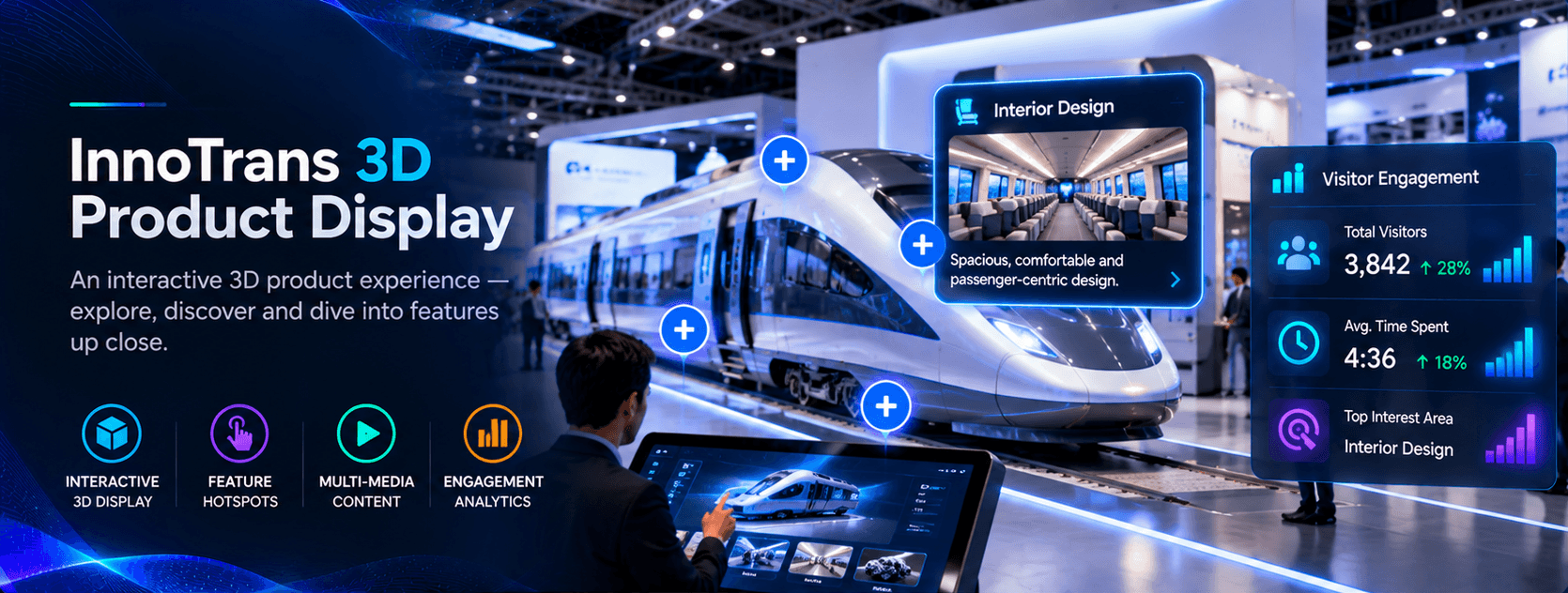
InnoTrans 3D Product Display
10 · Case Study
InnoTrans 3D Product Display
A large-scale interactive 3D rail experience for InnoTrans — built to make complex systems understandable on the floor.
- Role
- 3D exhibition experience lead
- Context
- InnoTrans · Berlin · Rail industry hall
- Collaborators
- Rail product engineeringExhibition designPresentation team
The Situation
Rail systems are spatial by nature — coupling, signaling, service context — but InnoTrans booths rarely have room for full-scale hardware. Posters and looped video fail to show relationships visitors need to grasp in one stop.
Goal & Expectations
Make complex rail offerings understandable through an interactive 3D display suited to hall viewing distances and live presenter use. Support both walk-up exploration and guided tours.
Challenges
The hard parts were rarely just creative. They were floor reality, feasibility and the people who had to run it live.
Scale and legibility
Large halls mean viewers approach from angles and distances. Labels, motion, and default camera positions had to read from the aisle, not only up close.
Presenter pacing
Live tours ran on a clock with groups rotating through. The display needed chapter jumps that matched presenter talk tracks without visible loading breaks.
Show-floor stability
Long exhibit days and bright hall lighting stressed hardware. The experience had to recover cleanly and avoid embarrassing frame drops during VIP walkthroughs.
Where I Came In
I came in to translate engineering narratives into exhibition-friendly 3D scenes and interaction beats. I joined presenter rehearsals to learn which relationships they pointed at physically when hardware was absent.
Approach
Focused on a small set of hero views with deliberate camera paths and annotated hotspots. Tested contrast and motion speed on the actual booth display, not only on office monitors.
What We Built
Visitors saw rail context spatially — how pieces connect and why it matters — while presenters could drive the same model for group storytelling. Walk-ups could orbit key views without waiting for a tour slot.
Other Teams Involved
Product engineering for accuracy, exhibition design for sightlines, and Hitachi presentation staff for tour scripts.
On the Floor
Worked with AV on brightness, color calibration, and backup display routing. Stayed for opening-day VIP passes to tweak default camera and idle motion.
End Result
InnoTrans delivered a spatial rail story that made system relationships tangible on the floor, supporting both self-serve and guided presentations.
Final Thought
Industrial 3D at a show is not a video game — it is a shared pointer for engineers talking to buyers. I think about the presenter who said, “finally I can show the coupling story without apologizing for scale models.” That is the bar.
Capability notes
For teams who want the build detail: the experience drew on the tools and patterns below. The story above is what visitors and stakeholders felt on the floor.
- Three.js
- WebGL
- 3DVista
- Interactive 3D
Client confidential — delivered for a brand presenting in this context. The client name is withheld under NDA.