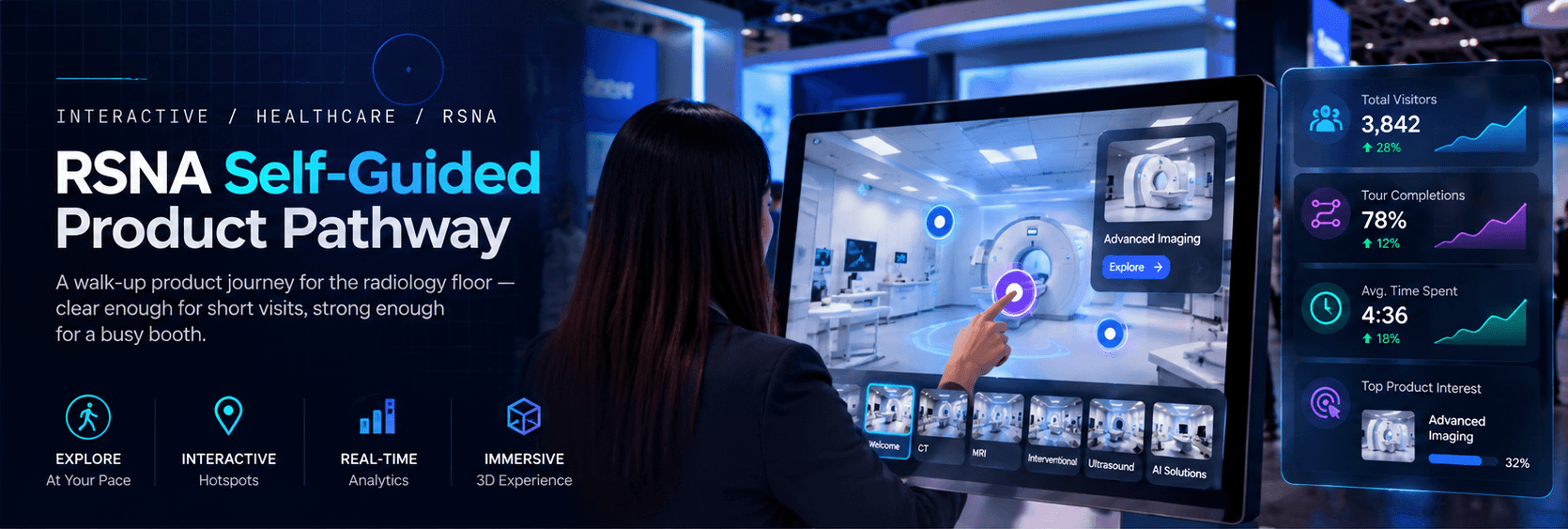
RSNA Self-Guided Product Pathway
01 · Case Study
RSNA Self-Guided Product Pathway
A walk-up product journey for the radiology floor — clear enough for short visits, strong enough for a busy booth.
- Role
- Creative technology lead
- Context
- RSNA · Chicago · Live radiology booth
- Collaborators
- Booth agencyProduct marketingField clinical team
The Situation
RSNA aisles never slow down. Visitors drift in with two minutes to spare while every rep is mid-conversation. The radiology portfolio is deep, but a queue for a guided demo kills momentum before the story even starts.
Goal & Expectations
Give walk-up visitors a clear product journey they could finish alone, without making the booth feel cold or unattended. Keep staff free to join when interest spikes, not gate every first touch.
Challenges
The hard parts were rarely just creative. They were floor reality, feasibility and the people who had to run it live.
Crowded floor, zero patience
Peak hours meant three people hovering at once. The experience had to reset cleanly, read at arm’s length, and never trap someone behind a long linear video.
Complex portfolio, simple path
Multiple modalities and use cases could not all be “chapter one.” The pathway needed sensible defaults for strangers and shortcuts for specialists who already knew the category.
Staff as partners, not crutches
Reps wanted to jump in mid-journey without breaking the visitor’s place. Handoff had to feel natural on a loud show floor.
Where I Came In
I joined after the creative direction was set but before build lock. My job was to turn the booth story into a touch journey that could run unattended all day — and to define what we would measure once the hall opened.
Approach
Mapped the product narrative into short, labeled steps with obvious “start here” entry and graceful exit points. Prototyped touch patterns on actual kiosk hardware so tap targets survived real fingers, not just design reviews.
What We Built
Visitors walked up, tapped in, and moved through the radiology story in bite-sized chapters. When a rep was free, they could pick up where the screen left off. Starts and completions gave the team proof of what worked after the show.
Other Teams Involved
Creative agency for visual system, client product marketing for story hierarchy, and booth operations for daily reset and content tweaks.
On the Floor
Worked with AV on kiosk placement, brightness, and cable routing before load-in. Ran on-site smoke tests the night before doors opened and stayed through first-morning traffic to tune idle screens and timeout behavior.
End Result
The booth stayed “open for business” even when every staff member was talking. Self-serve starts stayed steady through peak RSNA hours, with clear completion data for stakeholder review.
Final Thought
The best congress kiosk is not the flashiest screen — it is the one that respects how people actually move through a hall. I still think about that first busy morning: strangers finishing a pathway while reps closed deals beside them. That balance is what I aim for on every healthcare floor.
Capability notes
For teams who want the build detail: the experience drew on the tools and patterns below. The story above is what visitors and stakeholders felt on the floor.
- Touch interface
- React
- Kiosk packaging
- Event tagging
- Looker Studio reporting
Client confidential — delivered for a brand presenting in this context. The client name is withheld under NDA.